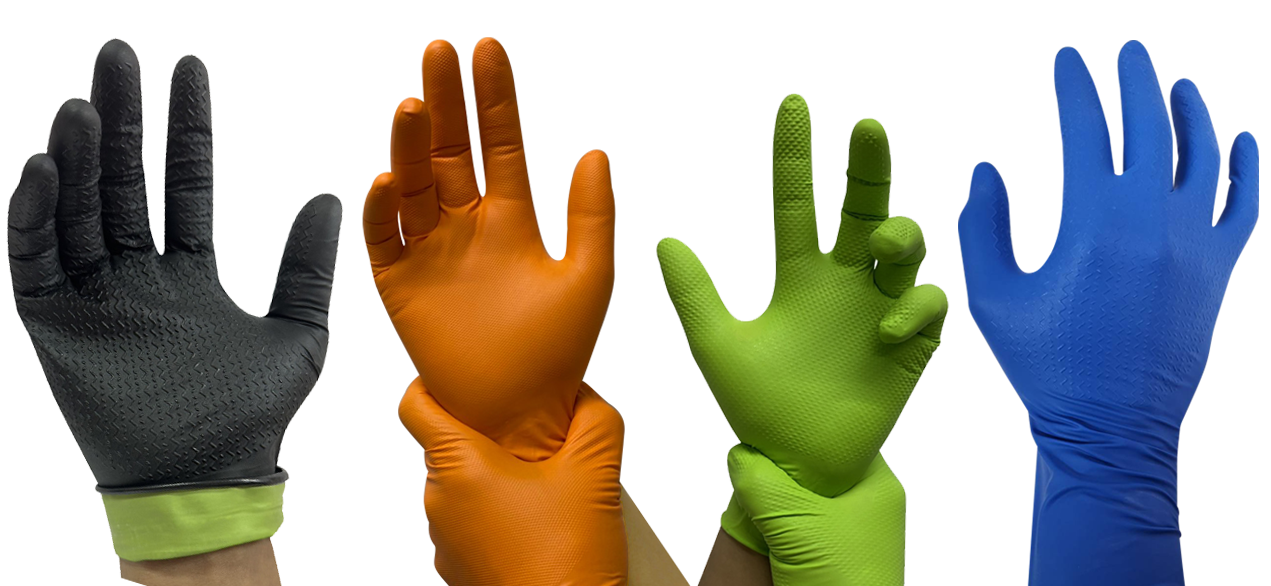
- Natural Rubber Latex. Made from natural rubber for outstanding stretch and a light, barely-there feel, giving you the tactile sensitivity that precise, detailed work demands.
- Powder-Free. Manufactured completely without powder, so there is no loose residue to contaminate your work or aggravate sensitive skin.
- Ambidextrous. Each glove fits either hand, so there is nothing to pair or sort. Pull on any two and get straight to work.
- Beaded Cuff. A rolled bead at the wrist braces the glove against tearing as you pull it on and helps stop liquids from rolling back down your arm.
- Second-Skin Comfort. A soft, pliable formulation flexes with the hand for a snug fit that keeps dexterity high and hand fatigue low, even across a full shift.
Latex
10 mil Fully Textured Latex Long Cuff
Latex 10.0 Mil Powder Free Long Cuff (High Risk) Gloves
- Viral BarrierEN ISO 374-5
- Medical GradeEN 455
- Material
- Latex
- Texture
- Fully Textured
- Surface treatment
- Mild Washing with Chlorine Solution and Extensive Washing
- Thickness
- 10 mil
- Length
- 290 mm
- Grade
- Disposable & Examination
Colours (1)
Blue
Sizes
X-SmallSmallMediumLargeX-LargeXX-Large
Certified & Compliant
Tested to International Standards.
This product is manufactured under Innovative Gloves' certified quality systems. The certifications and standards that apply to it are listed below.
Quality & Medical
- ISO 9001
- EN ISO 13485
- EN 455
- EU MDR
Food Contact
- US FDA 21 CFR 177.2600
- Overall Migration, EU Regulation 10/2011
Chemical & Biological Protection
EN ISO 374 Classification.
Independently tested chemical permeation, degradation and micro-organism protection, certified Type B to EN ISO 374-1:2016+A1:2018.
| Test Chemical | EN ISO 374-1:2016+A1:2018 / Type B | EN ISO 374-4:2019 |
|---|---|---|
| 40% Sodium Hydroxide (K) | Level 4 | -45.8% |
| 96% Sulphuric Acid (L) | Level 1 | +94.5% |
| 30% Hydrogen Peroxide (P) | Level 5 | -1.1% |
| 37% Formaldehyde (T) | Level 6 | -61.5% |
EN ISO 374-5:2016
- PassProtection against Bacteria & Fungi
- PassProtection against Viruses
Permeation performance levels 0–6 per EN ISO 374-1. Degradation (EN ISO 374-4) shows change in puncture resistance after contact; a negative value indicates swelling.